
Meet Khushal Luniya – A Young Tech Enthusiast, AI Operations Expert, Graphic Designer, and Desk Editor at Luniya Times News. Known for his Brilliance and Creativity, Khushal Luniya has already mastered HTML and CSS. His deep passion for Coding, Artificial Intelligence, and Design is driving him to create impactful digital experiences. With a unique blend of technical skill and artistic vision, Khushal Luniya is truly a rising star in the tech and Media World.


New Delhi, June 29, 2025
Ministry of External Affairs: “We reject this statement with the contempt it deserves”
India issued a firm and unequivocal rejection of Pakistan’s accusation that it was behind a deadly suicide attack in Waziristan, Khyber Pakhtunkhwa, calling the claim “baseless” and “deserving of contempt.” The Ministry of External Affairs (MEA) responded late Saturday night after Pakistan’s military publicly blamed India for the explosion that claimed the lives of at least 14 Pakistani security personnel and injured 25 more.
The blast occurred on June 28 in a high-security zone in North Waziristan, a region long marred by militant violence, ethnic tensions, and insurgent activity. While Pakistani authorities were quick to link the attack to “foreign handlers,” an official statement from the Pakistan Army specifically pointed to Indian involvement — a claim that New Delhi swiftly and strongly refuted.





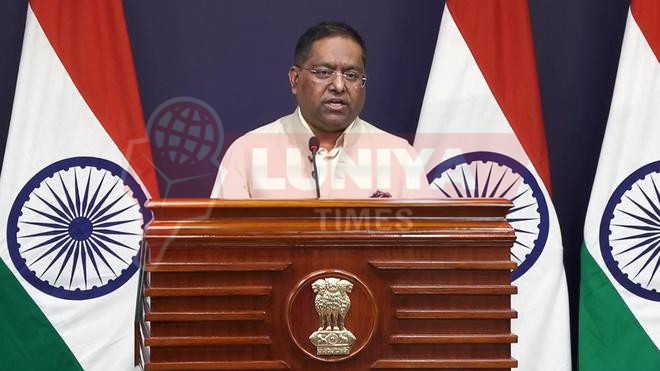
“We have seen an official statement by the Pakistan Army seeking to blame India for the attack in Waziristan on June 28,” the MEA said in a late-night release.
“We categorically reject such baseless and malicious allegations. We reject this statement with the contempt it deserves.”
The Attack in Waziristan
The suicide bombing took place during a routine security patrol in North Waziristan, an area close to the Afghan border that has witnessed numerous insurgent attacks over the past two decades. Local reports suggest the attacker detonated explosives near a convoy of military vehicles, causing significant casualties and damaging infrastructure in the surrounding area.
Security sources in Pakistan claimed the attack bore the hallmarks of groups allegedly backed by “foreign intelligence agencies.” Without offering evidence, the Pakistan Army’s media wing, ISPR (Inter-Services Public Relations), named India as the country “orchestrating chaos through proxies.”
India’s Swift and Stern Response
India’s Ministry of External Affairs dismissed the accusation as not only false but an attempt by Islamabad to divert attention from its own domestic challenges. The MEA emphasized that this pattern of blaming India after every internal mishap has become predictable and counterproductive.
“It has become routine for Pakistan to point fingers at India whenever there is a security lapse within its own borders,” the MEA statement noted.
“These attempts at externalizing internal failures only underscore the absence of accountability within Pakistan’s own institutions.”
Historical Context and Escalation of Rhetoric
The India–Pakistan relationship has long been strained, particularly over the issue of cross-border terrorism and the disputed region of Jammu and Kashmir. Over the years, both nations have accused each other of supporting insurgent elements to destabilize the other.
However, analysts have observed that Pakistan’s recent efforts to pin blame on India for internal militant attacks mark a new phase in narrative warfare — one that seeks to garner sympathy internationally while avoiding difficult domestic questions around governance, counterterrorism, and radicalization.
This latest diplomatic spat adds another layer to an already volatile regional atmosphere. India has consistently maintained that it does not support or fund militant operations in any neighboring country and has pointed instead to Pakistan’s own long history of providing safe havens to designated terrorist organizations like the Taliban (prior to 2021), Lashkar-e-Taiba, and Jaish-e-Mohammed.
Read More: राहुल गांधी का RSS पर प्रस्तावना विवाद पर कटाक्ष
Domestic Turmoil in Pakistan
Observers note that this incident also comes amid growing instability within Pakistan. The country is facing a worsening economic crisis, political uncertainty, and a resurgence of militancy along its western borders. Attacks in Balochistan and Khyber Pakhtunkhwa have surged in recent months, even as Pakistan has tried to present itself as a stabilizing force in South Asia.
Critics argue that the Pakistani establishment is increasingly using external scapegoats to deflect attention from internal dysfunction. India, due to its size and status as a geopolitical rival, becomes an easy target for these deflection strategies.
“Blaming India is an old playbook,” said South Asia analyst Dr. Kavita Singh of the Observer Research Foundation.
“The real issue is that Pakistan has failed to dismantle the militant infrastructure within its own territory. Turning this into a regional blame game helps no one and further isolates Islamabad diplomatically.”
Global Reactions and Strategic Silence
As of Sunday morning, there has been no public comment from major world powers such as the United States, the United Kingdom, or China. However, diplomats privately acknowledge that these accusations are unlikely to gain traction internationally without solid evidence.
India, meanwhile, has reached out to several strategic partners to reaffirm its position and highlight what it calls Pakistan’s continued use of “terrorist proxies” in its foreign policy.
The Way Forward: More Division or De-Escalation?
With both countries possessing nuclear weapons and a long history of armed skirmishes, any escalation in rhetoric is met with concern in international circles. Though this latest exchange has not yet resulted in any military standoff, experts warn that repeated accusations, misinformation, and inflammatory language can raise the risk of miscalculation.
Calls for bilateral dialogue have grown louder in recent years, particularly following ceasefire agreements across the Line of Control. However, trust remains elusive, and events like the Waziristan attack — and the fallout from it — only widen the diplomatic chasm.
“What South Asia needs is confidence-building and regional cooperation — not this dangerous blame game,” said Ali Raza, a peace studies researcher based in Geneva.
“Both countries owe it to their people to stop lurching from crisis to crisis.”
India’s firm rebuttal of Pakistan’s claim over the Waziristan suicide bombing underscores a deteriorating diplomatic environment. While the MEA’s rejection was strong in language, it also reflects New Delhi’s growing impatience with being routinely dragged into Pakistan’s internal crises.
As Islamabad continues to battle rising extremism within its borders, observers suggest the focus should be on internal reform and regional cooperation, rather than unproven allegations. Until then, India is likely to continue asserting its innocence — and its regional strength — through both words and actions.
Click here to join our WhatsApp Group
Donate Us
Your support inspires us to do better work for the society.